CASE STUDY
How creator videos went from raw recordings to 3 scored script variations in under 3 minutes
UGC creative testing was running blind. Videos were posted and results tracked, but there was no system for understanding what made a hook work or fail. When something performed, the win couldn't be repeated on purpose. This pipeline changed that by turning every video into structured creative intelligence before it ever goes live.
Video Walkthrough
Watch the full pipeline explained end to end — from raw UGC video to scored Airtable output.
THE PROBLEM
Good creatives were performing, but no one knew exactly why.
UGC videos were being tested across Meta with no structured framework for what was being tested. When a video performed well, the question was always the same: was it the hook, the emotional angle, the offer, or just the audience? Without a system for dissecting and scoring each video's components before launch, every creative test was a guess and every win was a one-off you couldn't replicate intentionally.
"The problem wasn't a lack of creative volume. It was that every video was treated as a black box. No transcript, no hook classification, no scoring. This system turns each video into a structured creative brief before it ever gets tested, so the learning compounds instead of disappearing after the campaign ends."
THE PIPELINE
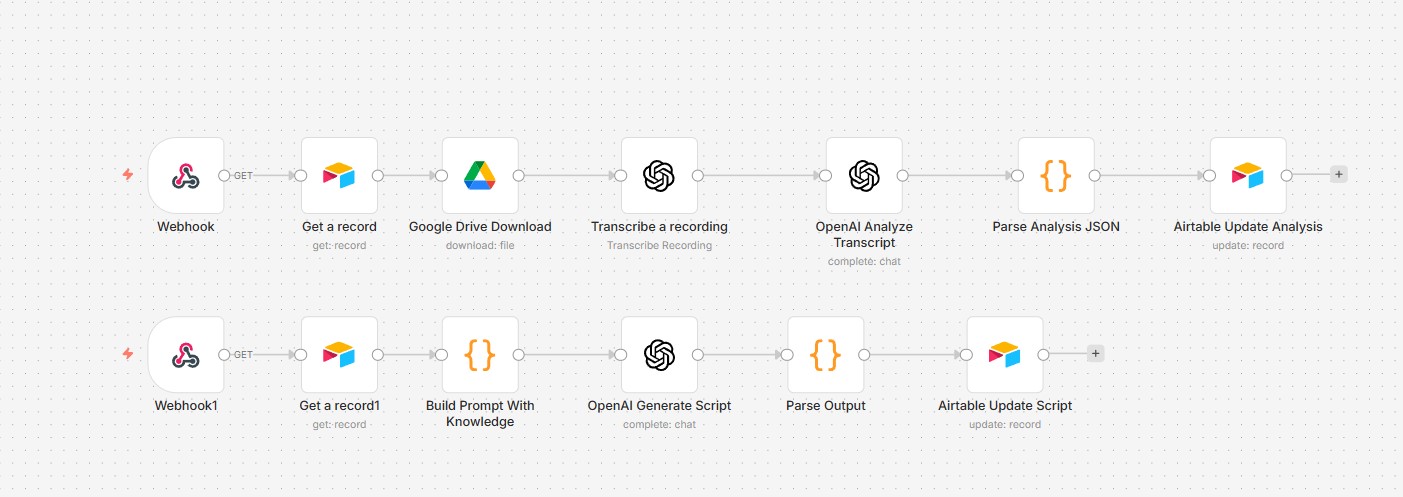
From raw video to scored variations, fully automated
HOW IT WORKS
Seven steps, zero manual brief-writing
Video is passed to the n8n workflow
No manual upload. The video URL or file path is the only input needed. The workflow handles everything from there.
OpenAI Whisper transcribes the full video
Full transcript generated from the audio, including timestamps. Works with any creator format: talking head, voiceover, product demo.
GPT-4o-mini classifies the hook type
Hook type identified from a fixed set: question hook, bold claim, story open, shock/pattern interrupt, social proof lead. The classification is logged, not just inferred.
Emotional triggers identified
The model identifies which emotional drivers the video leans on: fear, aspiration, curiosity, belonging, urgency. This becomes the basis for generating contrasting variations.
Original hook scored
The original hook is scored across three dimensions: clarity (is the hook immediately understood?), specificity (does it name the problem precisely?), and conversion potential (does it create enough pull to keep watching?).
3 UGC-style script variations generated
Three alternative scripts generated, each testing a different hook type or emotional angle from the ones not used in the original. Each variation is written in creator-native tone, not corporate copy.
Full output written to Airtable
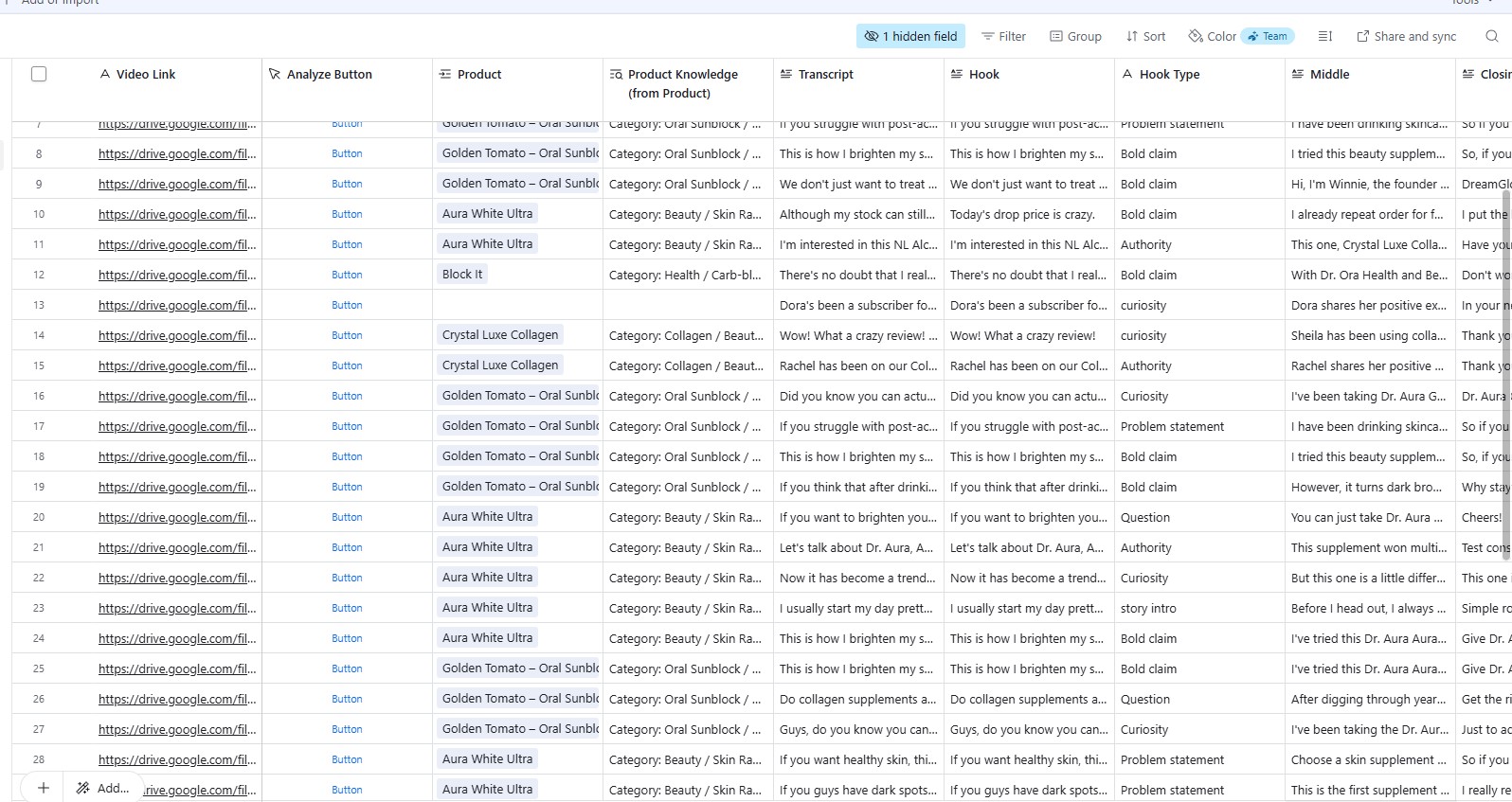
Every field lands in a structured Airtable row: original transcript, hook type, emotional triggers, score, and all three variations. Searchable by campaign, creator, hook type, or score bracket.
RESULTS
What the first batch returned
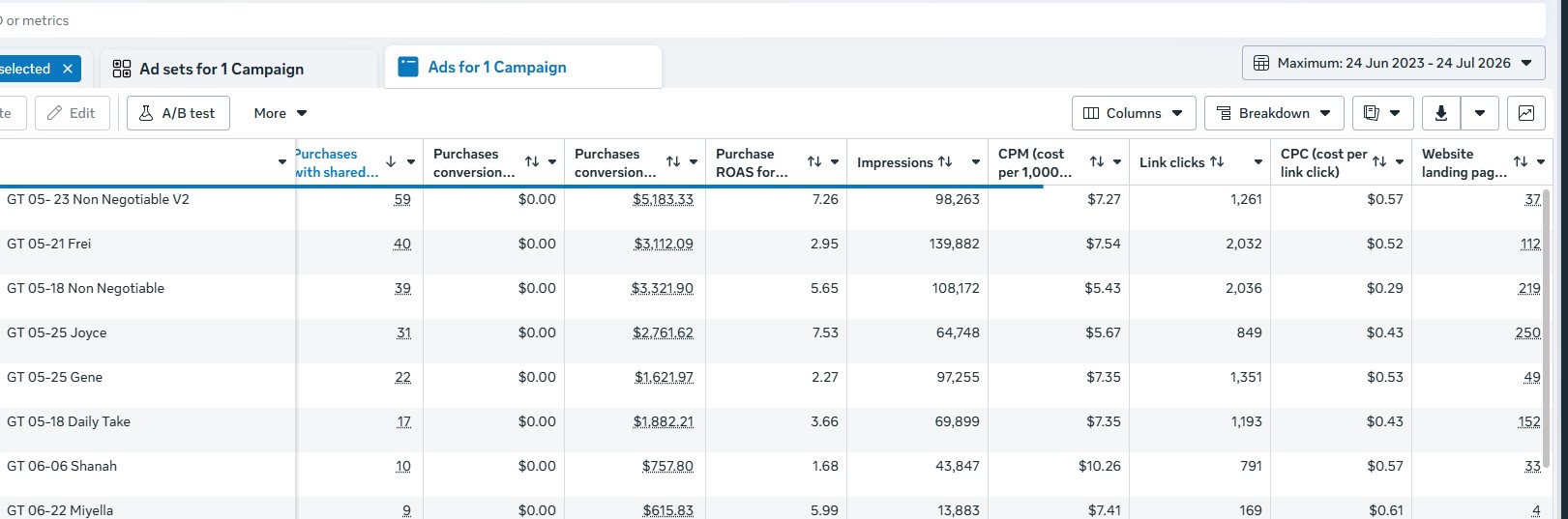
→ 133 purchases at 4.57x ROAS on first batch
The first creative batch run through this system returned 133 purchases at a 4.57x ROAS, the strongest first-batch result from any UGC test in this account.
→ Creative testing became hypothesis-driven
Instead of posting and hoping, every new creative test was paired with a specific hook type and emotional angle. Wins and losses now have a reason attached.
→ Under 3 minutes per video
From raw video to full Airtable row with 3 script variations took under 3 minutes per video. What used to take a creative strategist an hour now runs in the background while the team is on other work.
→ Creative library becomes a searchable asset
Every video analyzed builds a growing library of hook types, scores, and variations. The data compounds with every batch instead of being lost after each campaign ends.
KEY ENGINEERING DECISIONS
Why variations test different angles, not just rewrites
The first version of the prompt generated three variations of the original hook, which produced near-identical outputs with slightly different wording. This didn't help with creative testing because you need to know which angle works, not which phrasing of the same angle is slightly better. The fix was to force each variation to use a different hook type classification from the identified set, guaranteeing that each test is a genuine angle switch, not a surface-level rewrite.
"If the original video opens with a bold claim, the three variations should test a question hook, a story open, and a social proof lead. That's a creative test. Three versions of the same bold claim with different words is just editing."
Airtable was chosen over a spreadsheet because the structured field schema lets you filter by hook type, sort by score, and query across campaigns. A plain export would lose the relational value. The library only becomes useful at scale if the data is queryable.
SIMILAR USE CASES
Where this system applies
Any brand running UGC or creator content at volume, where creative performance varies but the reason for variation is never captured. Works for Meta, TikTok, or YouTube pre-roll. The hook classification and scoring framework adapts to platform format; the Airtable output structure stays the same.